

Storing Your RV AC for Winter: Covers, Gaskets and What to Check
Posted by RV AC Guys on 27th Oct 2026
Why your AC needs attention before storage
Your rooftop air conditioner doesn't need to be winterized the way your plumbing does; there's no water in the system to freeze. But months of sitting in rain, snow and wind is hard on the parts that protect it: the shroud, the roof gasket and the fan. A 30-minute check now can save you from a leak in February or a dead AC on the first hot weekend.
Your fall AC checklist
1. Clean or replace the filter
A dirty filter left in all winter holds dust and moisture. Dometic's manual says to clean the return air filter at least every two weeks of use and never to run the AC without it. Wash it with mild soap and warm water and let it dry completely, or replace it. Shop Coleman-Mach filters, Dometic filters and universal RV AC filters.
2. Look under the shroud
With the power off, remove the shroud and clear out leaves, pine needles and nests. Check the condenser and evaporator coils for dirt and the fan blade for cracks. An AC coil cleaner makes the job easier; follow the directions on the can.
3. Inspect the shroud
Cold makes plastic brittle. A shroud that's already cracked or chalky from the sun can break in winter wind and let snow and water reach the fan motor and wiring. If yours is cracked, replace it before storage. See our shroud replacement guide.
4. Check the roof gasket and mounting bolts
Fall and winter rain is when gasket leaks show up. Look for a gap between the base pan and the roof and check the ceiling around the AC for stains. Check the mounting bolts from inside, but don't just crank them down; tighten to your manufacturer's spec. Our roof gasket guide lists the specs and how to replace a worn gasket.
5. Check the roof sealant around the unit
While you're up there, check the sealant around nearby vents and seams. Water that gets in near the AC often gets blamed on the AC.
6. Run it one last time
Run the AC for a few minutes in cool mode and fan mode on a warm day (rooftop units aren't made to cool when it's cold outside) to confirm everything works. It's much easier to order a part in October than in May, when everyone else is too. If something's off, see fan motor vs. compressor or bad capacitor or frozen coil.
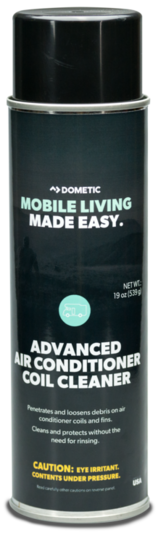
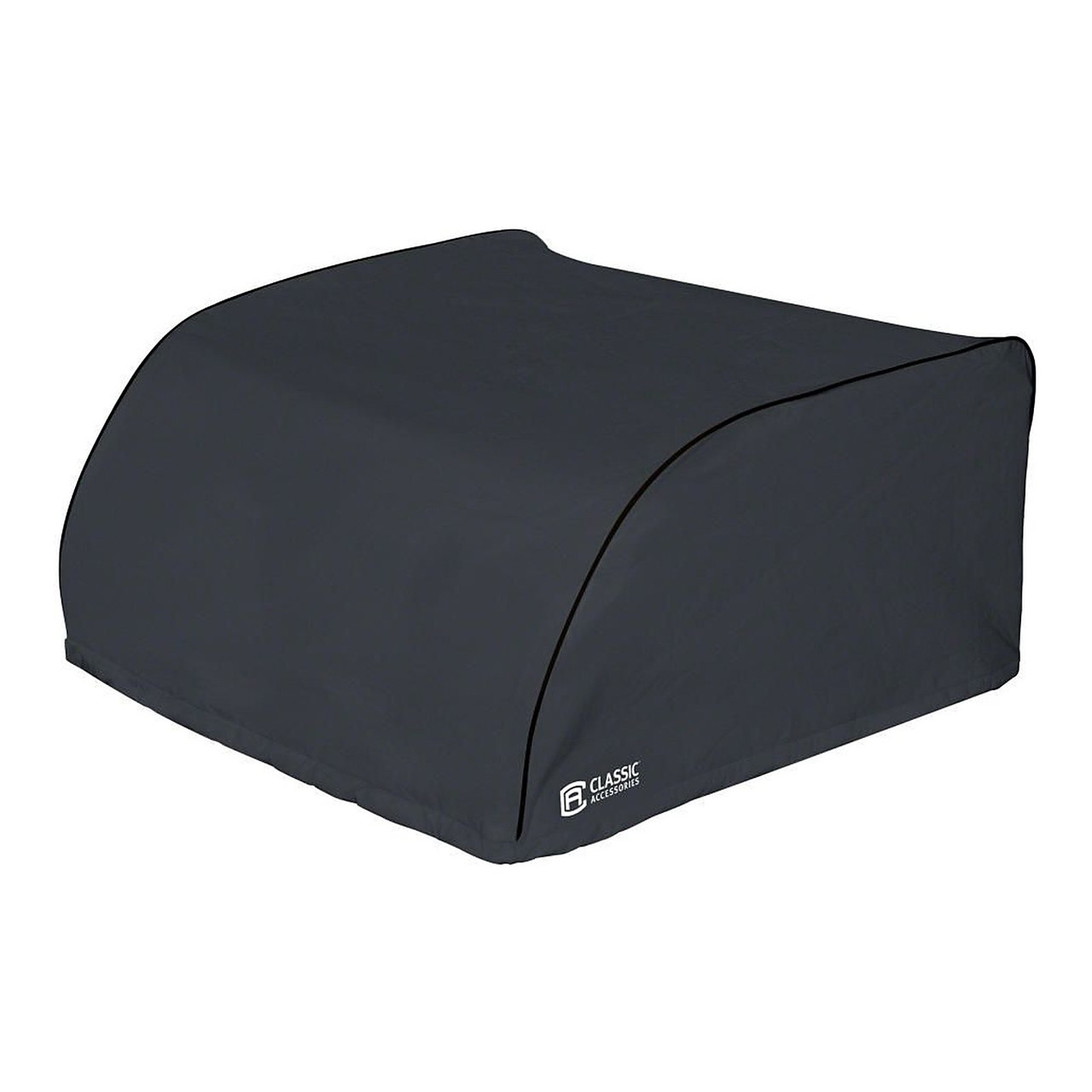
Dometic coil cleaner D1227001 (left) and a Classic Accessories cover for the Dometic Brisk II (right).
Should you cover your RV air conditioner?
A cover helps if it fits well. It keeps snow, ice and debris out of the unit and blocks UV on the shroud. The risks come from a poor fit: a loose cover can flap in the wind and wear on the shroud, and any cover that leaves gaps can let critters such as squirrels and wasps nest inside. Choose a cover made for your unit's model, fit it snugly, and check it after storms.
- Dometic Brisk Air / Brisk II: ADCO 3027, Classic Accessories (black), Camco 45392
- Dometic / Duo-Therm Penguin and low profile: ADCO 3016
- Coleman-Mach Mach 15, Mach III Plus, Mach I/III Power Saver: ADCO 3026
- Coleman-Mach Mach I, II, III and Mach 3 Plus TSR: ADCO 3023 (except 7100)
- Coleman Mini Mach and Super Mach: ADCO 3017
- Carrier: ADCO 3024
Check the cover's listed dimensions against your shroud before you order, and see all RV AC covers.
During storage
- Turn off the AC breaker if the RV will be plugged in, so the AC can't be switched on by accident in freezing weather.
- Run it occasionally if you can. Dometic's manual for some of its units says that when an RV sits unused for a long time, the AC should be run for 20 to 30 minutes about once every six months to keep components working. Pick a warm day.
- Check after big storms. Look for a displaced cover, broken shroud or ceiling drips.
Order parts now
If your inspection turns up a cracked shroud, a worn gasket or a noisy fan motor, the off-season is the best time to fix it. Start with your unit's model number (here's how to find it), and contact us if you need help matching a part.